SPA (SECTOR PERFORMANCE ACCELERATion) REPORT

Commercial Services: Where Value Is Won and Lost in a Stabilizing Market

Demand in Commercial Services remains steady. For some operators this stability is welcome, for others it exposes performance gaps that growth once masked. As market tailwinds fade, results are no longer shaped solely by demand. They are determined by execution.
What this report shows
  • Market stability is exposing execution-driven performance gaps.
  • Value leakage is driven by controllable operational, commercial, and financial factors.
  • Three levers explain most EBITDA variance in Commercial Services.
  • Performance Acceleration requires coordinated execution, not isolated initiatives.
Authored By
Ricky Nieto
Managing Director,
Performance Acceleration
Martin Gembis
Senior Director,
Performance Acceleration

Performance Levers That Drive Commercial Services Results

As growth moderates, leaders can no longer rely on market momentum to offset inefficiency. Performance now hinges on a small number of controllable levers.

Revenue and Share of Wallet

Capturing the full value of demand through disciplined pricing, retention, and account expansion.

Operational Execution

The ability to deliver consistent service outcomes at scale without margin erosion.

Financial Discipline

Converting operational and commercial performance into predictable EBITDA and cash flow.

The Market Context

The commercial services sector remains a large and resilient one, supported by recurring demand and essential operations. Yet stability at the market level does not translate into stability at the operator level

Commercial Services Core Sub-Sectors

The structure of the sector explains this disconnect.

A significant share of revenue sits in recurring, labor-intensive services — facility maintenance, cleaning, field services. These categories reward predictability and scale, but they also expose weaknesses in execution, pricing discipline, and financial visibility.

The market is also highly fragmented. Many mid-market operators compete locally with limited standardization, uneven workforce management, and minimal insight into branch-level performance.

The result is a widening gap between demand and realized value. Operators with similar market exposure produce materially different outcomes based on how well they manage complexity across operations, revenue capture, and financial control. This is where value leaks.

Where value leaks and how it is recovered

As Commercial Services markets stabilize, value creation is increasingly determined by a small number of controllable factors. Across engagements, Huron consistently sees value leakage concentrated in three areas. 

1. Revenue and Share of Wallet

Revenue growth is increasingly constrained by the quality of execution quality rather than market demand. Many operators pursue new customers while leaving revenue unrealized within existing accounts due to inconsistent delivery, weak communication, and uneven account management.
“Demand may be there, but revenue is still fought for every day. Customers rebid quickly, consolidate vendors, and shift to lower-cost solutions. Operators that are not actively managing accounts, building a pipeline, and reinforcing value give revenue back quietly.”
Ricky Nieto
Managing Director, Performance Acceleration
Revenue growth is a necessary condition for sustained value creation, but it is not an automatic outcome of market exposure. Too often, management teams react to macro conditions rather than actively shaping outcomes. Over time, this mindset limits investment in the commercial capabilities required to consistently convert demand into repeatable revenue.

Revenue growth drives the majority of value creation over longer holding periods

As holding periods extend, value creation increasingly shifts toward revenue growth, supported by margin improvement and cash flow efficiency rather than market-driven effects.

Commercial maturity evolves differently across portfolio companies following acquisition

Industries enter private equity ownership with materially different levels of commercial maturity. Manufacturing businesses often focus on stabilizing legacy commercial practices. Commercial services platforms typically present greater upside, where targeted intervention in business development, pricing, and sales effectiveness can drive compounding improvement over the hold period.
High-performing commercial services businesses engineer growth. They apply structured customer prioritization, coverage models, and disciplined pricing and pipeline management. They focus resources on accounts with the highest unrealized potential, expand share of wallet across adjacent services, and protect price integrity by service type.

The result is faster revenue growth and meaningful EBIT differentiation, without proportional increases in sales headcount or spend.

Despite this gap, most commercial services firms still consider themselves to be early or mid-stage in their commercial maturity. For many, the opportunity is not just incremental improvement, but rather structural uplift. When commercial execution becomes a core operating capability rather than a collection of ad hoc initiatives, growth becomes more predictable, resilient, and investable.


2. Operational Execution

Labor is the largest cost driver in Commercial Services, yet workforce deployment and branch execution remain uneven. As organizations scale, small inefficiencies in scheduling, utilization, and supervision compound rapidly.
“Most operators think they have an execution problem in a few places. What we see is that inconsistency across branches compounds quietly and erodes performance long before it shows up in financials.”
Ricky Nieto
Managing Director, Performance Acceleration
Operational inefficiency is often treated as a cost problem. In practice, it is a growth constraint. Variability in service delivery, underutilized labor, inconsistent estimating, and fragmented workflows slow the conversion of revenue into profit.

Operational Effort vs. Value Realized by Initiative (Implied ROI)

Across organizations, a disproportionate share of operational effort is absorbed by low-return activities. A small number of standardized initiatives generate outsized value relative to effort.

AI Adoption in Core
Operational Workflows

While many firms pilot AI, few embed it into core operational workflows at enterprise scale. The gap between experimentation and execution remains wide.
Operational excellence in commercial services is less about industrial optimization and more about reducing complexity and variability. High-performing firms standardize service offerings, estimating, and delivery practices. They tightly manage utilization across crews, technicians, and geographies.

This creates visibility into true job-level profitability and allows leadership to distinguish pricing problems from execution problems. Without this clarity, margin leakage is misdiagnosed and addressed too late.

From a private equity perspective, this gap represents opportunity. Firms that apply disciplined operational management can close productivity gaps while preserving the flexibility and cash generation that make services attractive investments.

3. Financial Discipline

Margin erosion is often driven by weak financial controls rather than poor pricing strategy. Inconsistent quoting, untracked scope changes, overtime creep, and delayed insight into job-level profitability prevent effort from translating into EBITDA.
"Job-level margins, pricing adherence, and working capital controls frequently lag behind growth, which makes performance harder to manage as the business gets more complex.”
Martin Gembis
Senior Director, Performance Acceleration
Financial discipline extends beyond reporting accuracy. In sponsor-backed environments, finance must translate operational and commercial activity into a credible, data-backed value narrative.

Many CFOs operate with fragmented systems, inconsistent data definitions, and limited visibility into performance drivers. This slows decision-making and undermines confidence with investors and boards.

How Finance Capacity Is Consumed Across Core Activities

A disproportionate share of finance effort is spent on reconciliation, manual close, and rework—leaving limited capacity for analysis and decision support.

Distribution of Month-End Close Performance

While a three-day close is often cited as a benchmark, most organizations require a week or longer.
High-performing finance organizations establish a reliable fact base connecting pricing, utilization, service mix, and cash flow. They focus on fewer, decision-relevant metrics rather than producing more reports.

From an exit perspective, financial discipline must be continuous. Buyers increasingly scrutinize data integrity, forecasting credibility, and performance repeatability. Always-on readiness reduces diligence friction, accelerates timelines, and supports stronger valuation narratives.

Let's discuss what levers to pull

Not every issue requires a full transformation. We start by understanding the context, then focus on the specific commercial and operational levers that can realistically move performance.

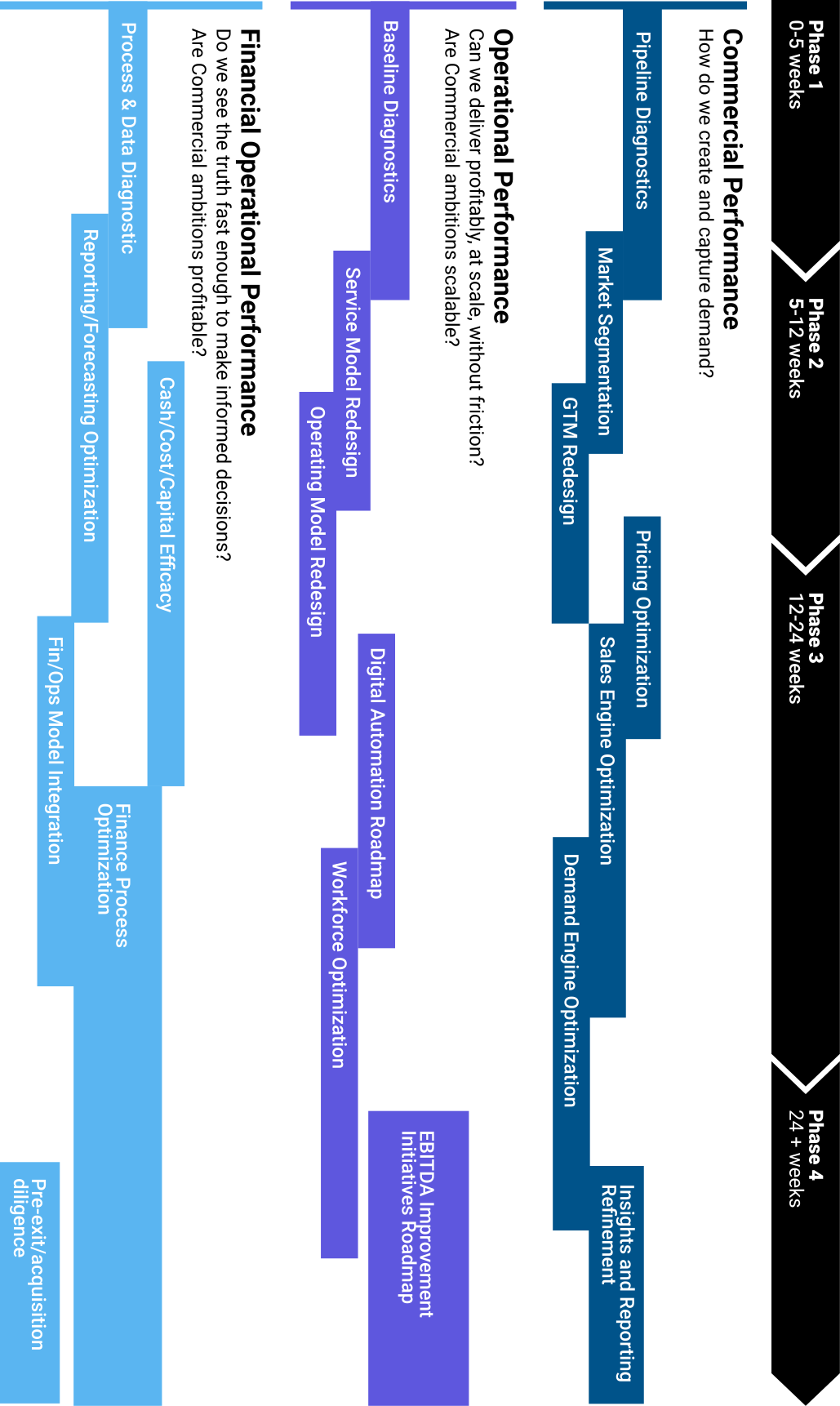
A Commercial Services Performance Acceleration Roadmap

Performance acceleration does not come from isolated initiatives. Sustainable value creation requires commercial ambition, operational scalability, and financial discipline to move in lockstep.

Commercial Performance defines where and how the business competes. Diagnostics, segmentation, GTM redesign, pricing, and demand engine optimization improve conversion and repeatability.

Operational Performance ensures growth is deliverable. Service model redesign, automation, and workforce optimization prevent margin erosion and execution risk.

Financial Operational Performance provides the control tower. A reliable fact base, improved forecasting, and FinOps integration connect actions directly to EBITDA, cash, and enterprise value.

The result is an integrated performance system that compounds value over time.

Huron Performance Acceleration Framework

Huron’s Performance Acceleration Services

Performance Acceleration is a coordinated system that aligns Commercial Excellence, Operational Excellence, and Financial Discipline around a single outcome: sustained EBITDA improvement. 
Rather than addressing growth, margin, or reporting in isolation, Huron connects how companies sell, deliver, and measure performance into a repeatable operating model.
Commercial

Go-to-Market Strategy

  • Go-to-market design and refinement
  • Route-to-market and coverage models
  • Commercial operating model alignment

Sales Efficiency and Effectiveness

  • Sales process and pipeline optimization
  • Sales capacity and productivity analysis
  • Performance management and incentives

Growth and Strategic Planning

  • Voice of customer programs
  • Market assessment and segmentation
  • Demand and growth opportunity sizing
  • Practice efficiency and site-level performance

Market and Customer Intelligence

  • 3–5 year corporate and business unit growth plans
  • Portfolio and business unit strategy
  • Strategic growth initiatives
OPERATIONAL

Operational Excellence

  • EBITDA improvement initiatives
  • Corporate and shared services optimization
  • Business function effectiveness

Domain Rationalization

  • Product, service, and SKU rationalization
  • Customer and account rationalization
  • Portfolio and business unit simplification

Digital Enablement and Automation

  • Digital strategy and roadmap development
  • Technology enablement and automation
  • Data, reporting, and performance transparency

Integration and Transformation Execution

  • Post-merger integration execution
  • Carve-out and separation support
  • Operating model redesign

Service and Delivery Optimization

  • Service operations redesign
  • Workforce and capacity optimization
FINANCIAL

Office of the CFO Transformation

  • Finance process optimization
  • Accounting and financial reporting
  • Financial planning and analysis enhancement

Cash, Cost, and Capital Management

  • Cost structure optimization
  • Cash flow and working capital improvement
  • Capital allocation support

Financial and Operational Modeling

  • Integrated financial and operating models
  • Scenario analysis and performance forecasting

Transaction and Value Readiness

  • Pre-acquisition diligence support
  • Pre-sale planning and exit readiness
  • Assessment of strategic alternatives
CASE STUDY

Post-Close Financial and Operational Reporting

Post-Close Financial and Operational Reporting

Commercial Landscaping
Situation
A private-equity-owned roll-up of commercial landscaping companies in the southeastern United States was operating with fragmented financial data, limited visibility into performance, and inconsistent reporting across eight acquired businesses. Each entity ran its own ERP and processes, making it difficult to forecast cash, manage capital, or identify operational improvement opportunities.
What We Delivered
  • Rapid diagnostic of financial and operational data across all operating entities
  • Standardized FP&A, CapEx, and spend governance processes
  • Branch-level cash flow forecasting and variance reporting
  • Management reporting to support accountability and decision-making
KEY RESULTS
EBITDA Improvement
Identified multiple operational initiatives with EBITDA impact across fleet lifecycle costs, labor productivity, routing efficiency, and pricing discipline.
Forecast Accuracy
Implemented a standardized 13-week cash flow forecast across all operating entities, improving short-term liquidity visibility and variance management.
Margin Protection
Standardized spend approvals and expense policies, reducing discretionary spend leakage and improving compliance across the platform.
CASE STUDY

Pre-Sale Growth Strategy and Value Creation Plan

Pre-Sale Growth Strategy and Value Creation Plan

Tile & Flooring Distributor
Situation
A PE firm evaluating exit options for a $250M revenue tile and flooring distributor needed to determine whether meaningful incremental growth could be achieved prior to sale. The business was caught in the “middle” of the market, larger than small regional players but without the scale advantages of national competitors.
What We Delivered
  • Comprehensive market and growth opportunity assessment
  • Customer, channel, product, and geographic segmentation analysis
  • Interviews with employees, customers, suppliers, and industry experts
  • A quantified go-to-market strategy and prioritized growth roadmap
KEY RESULTS
Incremental Revenue
Quantified a path to $60M+ in incremental revenue and approximately $11M in EBITDA over a 24-month horizon.
Execution-Ready Value Creation Plan
Delivered a detailed, time-phased implementation roadmap to support management execution and PE exit planning.
Go-to-Market Focus and Clarity
Defined clear customer, channel, and geographic priorities, enabling management to concentrate resources on the highest-return opportunities.
CASE STUDY

Stabilizing Operations and Improving Access

Stabilizing Operations and Improving Access

Multisite Specialty Care Provider
Situation
A fast-growing specialty healthcare provider was experiencing rising patient wait times, inconsistent scheduling practices, and declining provider utilization across multiple locations. Growth had outpaced operational discipline, creating access bottlenecks and performance variability by site.
What We Delivered
  • Standardized scheduling and patient access processes
  • Redesigned provider templates and onsite workflows
  • Capacity modeling and throughput analysis
  • KPI dashboards and operating cadence for site leadership
KEY RESULTS
Patient Access Improvement
Reduced average patient wait times by 28 percent through standardized scheduling and workflow redesign.
Operational Consistency Across Sites
Implemented standardized access and scheduling processes across all locations, reducing site-to-site performance variability.
Scalable Operating Model
Established an operating foundation capable of supporting continued growth without incremental administrative burden.

The Performance Acceleration Team

Ricky Nieto

Managing Director

Ricky is a senior transformation leader with extensive experience helping private equity firms and portfolio companies execute large-scale commercial and operational change.

He specializes in translating strategy into action for complex, multi-location service businesses, aligning go-to-market execution, service delivery, and governance to drive EBITDA improvement. Ricky has led enterprise-wide transformations across service operations, logistics, retail services, and field-based organizations, often working directly with CEOs and operating partners.

His work is grounded in accountability, cadence, and results, not theory.

Paul Shapiro

Operating Managing Director

Paul is an operator at heart, known for stepping into complex service and distribution environments and driving measurable performance improvement.

He has led hands-on transformations across supply chain, service operations, customer experience, and workforce productivity for multi-site, asset-intensive businesses. Paul frequently partners with leadership teams to stabilize operations, standardize processes, and unlock margin through practical execution rather than broad reorganization.

He is especially effective in situations where growth has outpaced operational maturity.

Stephen Koinis

Managing Director

Steven specializes in enterprise performance improvement and value creation for private equity–backed commercial services and industrial businesses navigating growth, integration, and operational complexity.

He works with leadership teams to stabilize performance, align operations to investor objectives, and unlock EBITDA through disciplined execution across commercial, financial, and operational levers. Steven’s experience spans diligence support, post-merger integration, and transformation programs where underperformance, complexity, or scale constraints limit results.

He partners closely with management teams to turn strategic intent into executable operating models that drive measurable, durable performance improvement.

Marty Gembis

Senior Director

Marty advises private equity sponsors and management teams on transactions, commercial strategy, and operational improvement, with deep experience in industrial and services-adjacent businesses.

His work spans pre-close diligence, carve-outs, and post-close value creation initiatives, including pricing, margin expansion, working capital improvement, and organizational alignment. Marty is often brought in when companies need clearer line of sight from commercial activity to financial performance.

He brings a structured, data-driven approach well suited to fragmented, multi-location service platforms.

Ryan Crockett

Director

Ryan partners with private equity sponsors and leadership teams to drive transaction readiness, value creation, and financial discipline across industrial and commercial services businesses.

He brings deep experience in commercial diligence, carve-outs, integrations, and performance improvement, with a focus on building scalable financial and operating models that support predictable growth. Ryan has led engagements spanning fleet-based services, manufacturing-adjacent field operations, and multi-site businesses where margin visibility, pricing, and capital allocation are critical.

Ryan is often engaged pre- and post-close to help management teams move from reactive decision-making to repeatable, sponsor-grade execution.

Jordan Mueller

Director

Jordan focuses on complex transformation, restructuring, and integration efforts for sponsor-backed companies navigating operational and financial pressure.

He has led initiatives across cost structure optimization, cash flow forecasting, service model redesign, and post-merger integration, frequently reporting directly to CEOs, CFOs, and boards. Jordan’s experience is particularly relevant for commercial services businesses facing margin compression, customer concentration, or rapid scale through acquisition.

He brings clarity and control to situations where execution risk is high.

Why Commercial Services Leaders Partner with Huron

The leaders who come to Huron are not looking for theoretical decks or distant strategy. They want disciplined execution, clarity amid complexity, and a partner who can work shoulder to shoulder with their teams. That is where Performance Acceleration excels.

Senior Operators, Not Just Advisors

Huron engagements are led by senior practitioners who work closely with management teams, driving real change rather than delivering strategy decks.

Integrated Commercial, Financial, and Operational Expertise

Huron aligns go-to-market execution, operational discipline, and financial rigor so improvement efforts reinforce each other.

Clear Accountability to EBITDA and Financial Outcomes

Decisions are grounded in impact, ownership, and measurable value creation.

Have any questions regarding our process? Get in touch now

Connect with our team to discuss how Huron helps commercial services organizations identify, capture, and sustain performance improvement.

Let's discuss what's possible.